Focus is a Muscle, but the "Return" is the Skill


We have been sold a perfectionist’s myth about focus.
The myth says that if you were truly productive, you would sit down at 9:00am and enter a state of "flow" that remains unbroken until lunch. It tells you that every time you check your phone, drift into a daydream, or get startled by a email notification, you have failed.
But in a world of infinite input and AI-accelerated noise, "perfect focus" isn't just rare, it's fragile.
If your ability to do great work depends on the world being silent, you aren't focused. You’re just lucky. To survive the modern world, you don't need more Control. You need Attentional Competence.
The Physics of the "Snap-Back"
Attention is a physical system. And a stable system isn't one that never moves. It's one with a high restoring force.
Think of the suspension on a high-end mountain bike. Its job isn't to make the trail flat, but to absorb the rocks and return the frame to center as fast as possible.
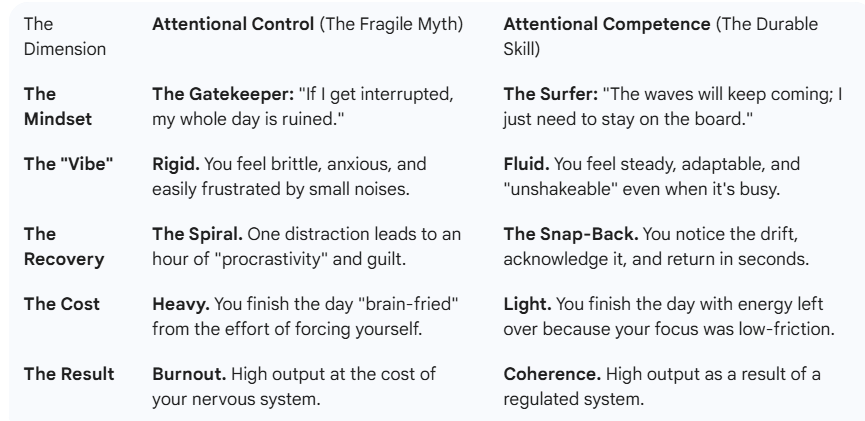
Attentional Competence is your mental suspension. It is the velocity of your "return." It is the skill of noticing you have drifted and bringing yourself back to center without frustration, without judgment, and without the "second arrow" of self-guilt.
Which System Are You Running?
Most of us try to manage our minds by acting like a Gatekeeper, trying to block out a world that refuses to be quiet. Attentional Competence allows you to act like a Surfer—someone who acknowledges the waves but knows how to stay on the board.
Why "Trying Harder" Increases the Static
When focus breaks, our instinct is to apply pressure. We grit our teeth and try to "force" ourselves back to work.
But pressure increases Internal Noise (Entropy). By scolding yourself for a distraction, you are actually giving your brain more data to process. You trigger "Threat Mode," which makes your attention even more reactive.
Effort feels like productivity, but it’s often just friction. Competence, on the other hand, is about lowering the friction of the return.
How to Practice the Return
You don’t build this skill by waiting for a perfect four-hour block of deep work. You build it in the mundane moments of your day.
Every time you notice your mind has wandered while washing a dish, walking to your car, or reading a paragraph—and you gently bring it back—you are doing a "rep." You are training your nervous system that the Return is safe and easy.
Over time, your "Internal Noise Floor" drops. You stop fearing distractions because you know they can’t break you. You become expensive to distract and very cheap to reset.
In an AI-driven world, you cannot eliminate the noise. But you can build a system that moves through the noise without becoming it.
You don’t need perfect focus. You need a dependable return.
Stay curious!
👇 Follow along for short, practical essays on mental clarity in a modern world that constantly pulls your attention. Forever free directly to your inbox.
