AI and Algorithms Aren't Competing for Your Time. They're Competing for Something More Fundamental.

You've probably heard that social media is designed to be addictive. That algorithms are engineered to keep you scrolling. That your phone is a slot machine in your pocket.
You've heard it. You believe it. And yet here you are, still feeling frayed, still losing hours you didn't mean to lose, still ending the day with that strange exhaustion that has nothing to do with what you actually accomplished.
That's because the conversation stops at the wrong place.
The real target isn't your time. Time is just the measurement. What's actually being competed for — what every algorithm, every notification system, every AI-optimized feed is precision-engineered to capture — is your attention.
And attention is not the same thing as time.
Time is neutral. An hour spent in deep focus and an hour spent fragmenting across thirty browser tabs are the same hour. But they produce entirely different outcomes — not just in what gets done, but in how you feel, how clearly you think, and what kind of person you're being while it happens.
Modern AI doesn't guess what will hold your focus. It knows.
It learns your specific pattern of engagement — what makes you linger, what makes you click, what emotional register keeps you in the feed for another thirty seconds. It updates in real time. It is, in the most literal sense, a system built to redirect your attention away from what you intended and toward what serves the platform.
This isn't a conspiracy. It's a business model. And it works because attention, once captured, is genuinely hard to reclaim. The research is clear: a single notification interruption costs an average of twenty-three minutes of recovered focus. Multiply that across a typical day and the numbers become difficult to look at.
The solution most people try is discipline. Try harder. Use more willpower. Delete the apps, then reinstall them, then feel guilty.
It doesn't work because it mistakes the nature of the problem. This isn't a personal failing. It's a design imbalance — sophisticated, well-funded systems on one side, and an undefended human mind on the other.
What actually works is building a counter-structure.
Not a perfect one. Not a radical digital detox or a monastic rejection of technology. Just a simple, repeatable system for noticing what's draining your attention, protecting small blocks of time from interference, and gradually learning what actually restores your focus versus what only feels like rest.
That's the work. It's quieter than the problem. But it adds up.
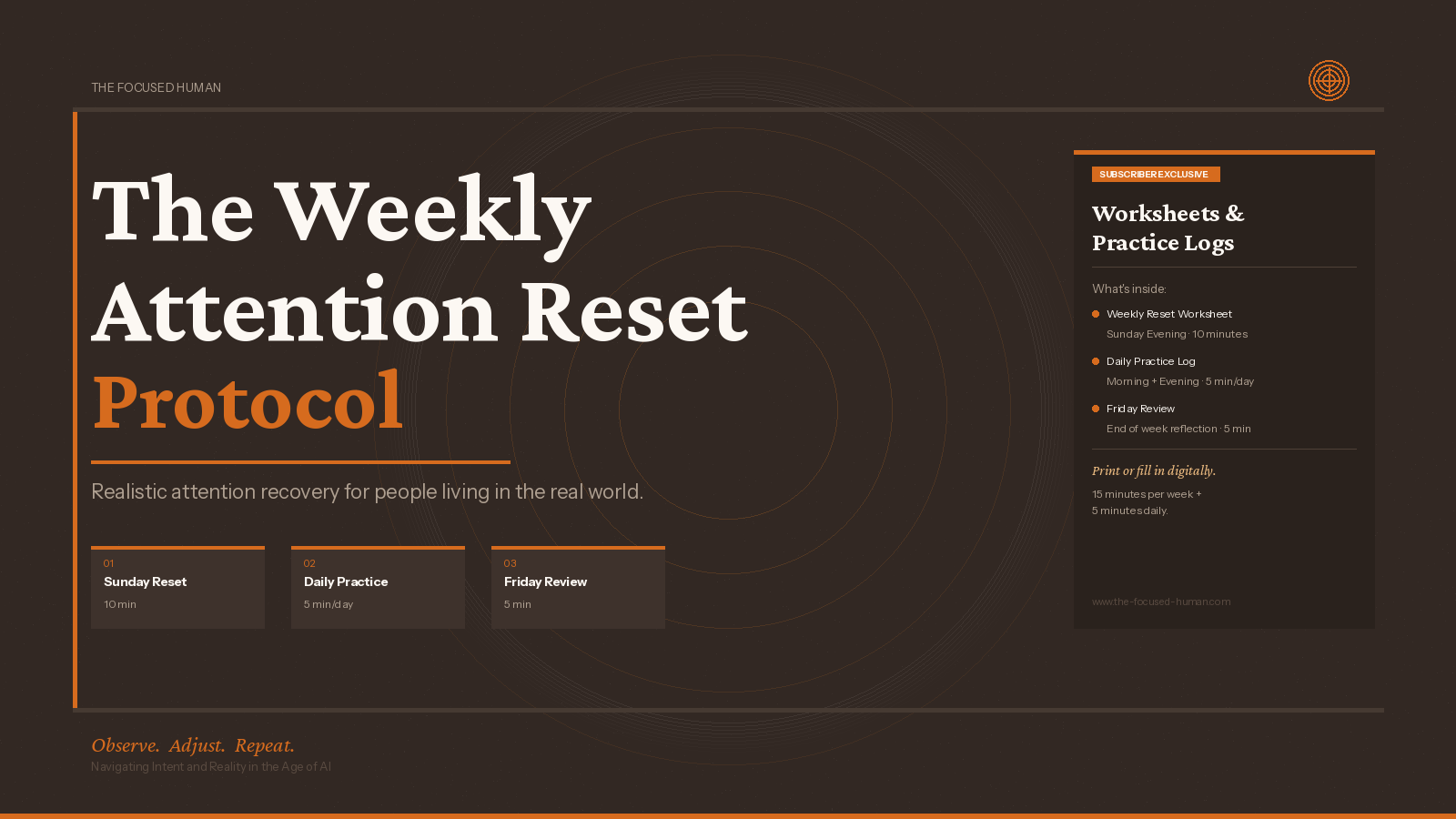
If you want a starting point, the Weekly Attention Reset Protocol is a free, printable system built around exactly this — 15 minutes on Sunday, 5 minutes a day. You can find it at protocol.the-focused-human.com or subscribe for free and receive access to download it.
Stay curious!
