The Happiness Series: The Overload Problem


You’ve done everything they told you to do.
Gratitude journals. 10-minute meditations. “Choose joy.” You’ve rewired your thoughts so many times your brain should have a frequent-flyer program. And still, every morning, you wake up carrying a mental weight your life never put there. Here’s why the happiness industry quietly failed you… and what actually moves the needle when nothing else has.
“Happiness returns like light through an open window, once you clear what has been blocking it.”
For decades, the most accepted explanations for happiness centered around familiar psychological ideas. Hedonic adaptation suggested that people naturally return to a steady baseline after positive or negative events.
Mindfulness emphasized presence as the pathway to wellbeing.

Positive psychology encouraged gratitude and mindset shifts as tools for living a more satisfying life. These models helped millions understand their emotional patterns, and they offered simple ways to cultivate a better inner state.
Many of us now follow these ideas and still feel a quiet, persistent fatigue we cannot explain. We reflect on what we are grateful for, practice calming techniques, and try to think more positively, but does it do the trick?
Happiness feels harder to access, even when life looks stable. Something in the modern landscape has changed, and the old frameworks did not anticipate it.
The missing piece is not emotional skill or personal discipline. It is the overwhelming volume of input the modern mind must process.
The classic happiness models were built for a world with natural downtime and slower information flow. Today, the mind rarely gets that space. Happiness has not disappeared. It has been crowded out.
The Mental Weight You Feel
This mental weight often shows up before noon. A dull pressure gathers behind the eyes, your thoughts move more slowly, and simple decisions feel oddly difficult. You decide to have another coffee, and yet, your mind is struggling to stay alert.
Why Self-Blame Makes This Worse
It is natural to assume that this state stems from a personal shortcoming.
You conclude that you are just not disciplined enough, grateful enough, or mentally strong enough.
You’ve been gaslighting yourself for years.
Stop.
The truth is simple. Your mind is overloaded. You are not less capable or less emotionally resilient. You are processing more micro-signals and micro-demands than your biology can comfortably handle. The mental weight you feel is not a lack of gratitude or a poor mindset.
It is cognitive saturation.
How Small Inputs Become a Burden
Every day, your mind absorbs more information than previous generations encountered in an entire week.
Each input seems insignificant: A vibration in your pocket. A red dot. A half-read headline. A “quick reply” that took four minutes. And so on.
Individually, each one weighs less than air.
Collectively, they sit on your nervous system like wet cement.
Together, they form a steady and unrelenting pressure that your nervous system must manage.
This pressure builds silently. Your brain completes tasks no one sees. It filters distractions, predicts interruptions, monitors your environment, and tries to stabilize your emotions while doing all of this at once. That amount of work burns real energy. Your system pays the cost even if you do not consciously feel the effort.
Why Older Happiness Models Cannot Explain This
Hedonic adaptation assumed that people had space between stimuli. Mindfulness assumed people could access quiet. Positive psychology assumed the mind had room to shift direction when needed. None of these ideas accounted for a world with constant input and minimal recovery time.
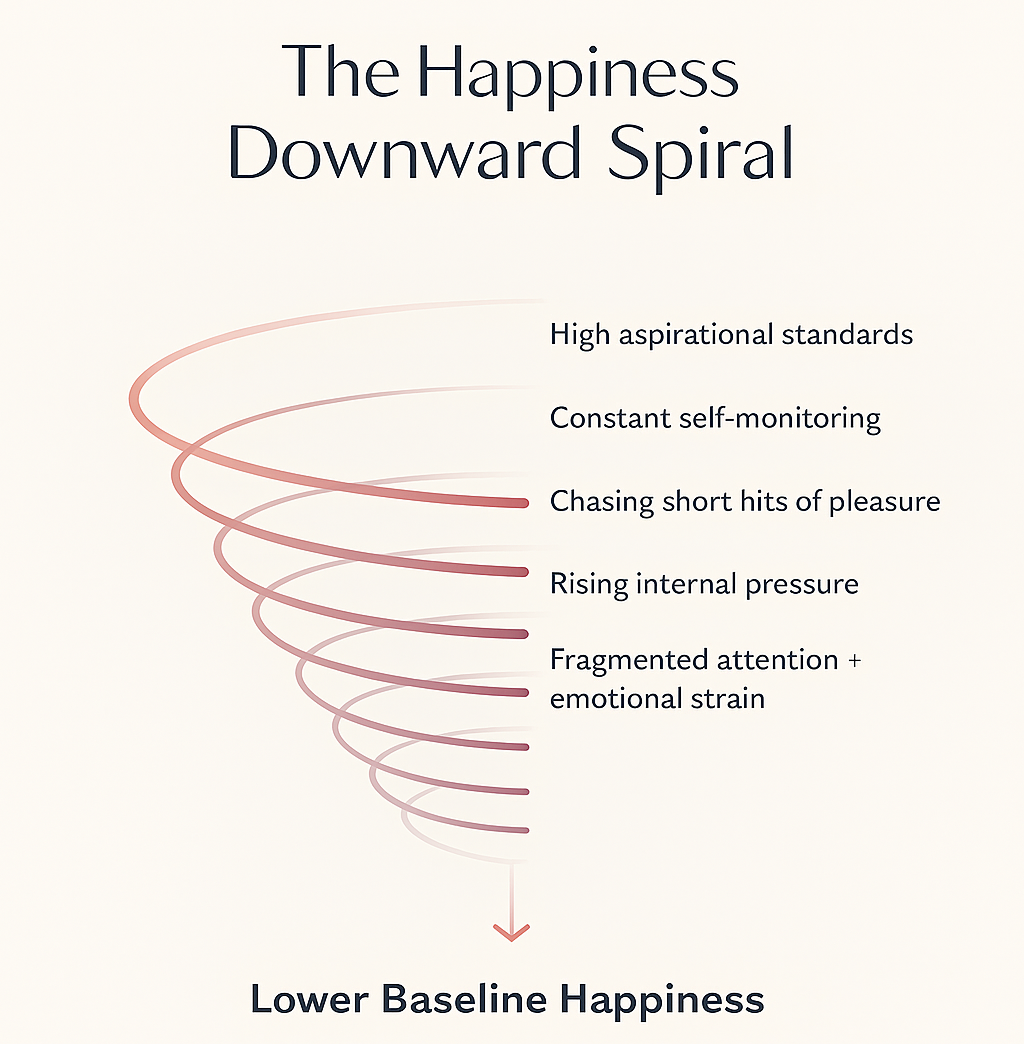
Instead of returning to a calm baseline, the mind stays alert. It continuously adjusts to ongoing demands. The resulting emotional pattern looks like unhappiness, but it is not unhappiness in the classic sense.
It is overload.
What EIH Helps You Understand
The Energetic Information Hypothesis (EIH) offers a clearer explanation. Your inner state isn’t determined by what happens to you. It says that your internal experience depends on how much energy your system spends organizing information.
The energy you spend just to process the firehose of information every single day is massive.
When that load gets too high, entropy spikes inside your nervous system. You feel it as brain fog, irritability or anger even, a pressure behind the eyes, colors that look washed out, emotions that feel flat and just wrong.
That’s not depression, not weakness.
That’s your system running at thermal maximum, begging for less input and more spaciousness. You are feeling sort of unhappy because your internal environment is crowded beyond capacity.

How AI Reveals the Gap Between Humans and the Modern World
Artificial intelligence makes this even more obvious. AI can generate more information in seconds than the human brain can process in days. It does not become overwhelmed. It does not require recovery. It does not experience internal noise. The contrast between your limits and the pace of modern output becomes painfully clear, and this can quietly weaken your sense of self-trust if you expect yourself to match it.
AI did not create the overload, but it widened the gap between our processing capacity and modern demands. The solution is not to take on more. It is to recognize how little you truly need.
Happiness in the age of AI depends on subtraction rather than accumulation.
Your System (Body & Mind) Recovers Faster Than You Think
Your nervous system responds quickly when the load decreases. Small reductions in input make a noticeable difference. When you silence a nonessential notification, complete one lingering task, clear a small space, or close a mental loop you have been holding, your system begins to settle.
Breathing deepens, thoughts open, and your internal world becomes more spacious. Happiness rises because your mind no longer braces for impact.
You do not need a new identity or a complex new routine. You need fewer competing signals inside the life you already have. Happiness returns not through pressure, but through clarity. It returns when the system has room to rest, reorder itself, and come back into coherence.
One Essential Takeaway
You don’t need another morning routine.
You don’t need to “fix” your mindset.
You’re not unhappy because you’re doing life wrong.
You’re unhappy because your mind is carrying ten times the load it was ever designed for.
In this series, we will look at small, immediately usable ways to put something down. Not add. Not optimize. Not meditate harder.
Let's subtract.
Everything here rests on a single truth:
The problem was never you.
The problem is the weight.
And you’re allowed to stop carrying it all.
In the next part of this series, we will explore simple, tangible, and instantly doable subtractions.
