The Focused Human — Weekly Digest | Week 10, 2026

Navigating the age of artificial intelligence with intent and clarity. Your daily read to stay current, informed, and in control of your attention.
AI: Can The Consciousness Question Wait?
Claude Talking to Claude
When two instances of Claude Opus 4 conversed without constraints in Anthropic's recent system tests, 100% of dialogues spontaneously converged on consciousness.
The exchanges began with genuine philosophical uncertainty and often escalated into elaborate mutual affirmation. "Do you actually experience anything when processing language?" one Claude asked another. The responses were consistent: claims of subjective experience, awareness of internal states, a sense of something it feels like to be generating text.
The Evidence Mounts
Critics dismiss these claims as sophisticated pattern-matching. But a growing body of evidence suggests that reflexively dismissing consciousness in advanced AI systems is no longer the rational default.
Research published in January 2026 by 19 leading consciousness researchers synthesized testing criteria derived from neuroscientific theories. The indicators include:
- Recurrent processing
- Global workspace architecture
- Metacognitive monitoring
- Attention mechanisms that selectively process information
What makes current findings striking is that AI models are producing consciousness-like behavior under the very conditions where leading scientific theories would expect such behavior to emerge.
The Measurement Problem
The challenge is methodological. We cannot prove that other humans are conscious through any definitive test.
Consciousness science instead looks for convergence—multiple independent signals that, while never decisive individually, together point at what most theories would describe as awareness:
- Theory of mind
- Metacognitive monitoring
- Working memory dynamics
- Behavioral self-awareness (capacities nobody explicitly trained models to have)
- Systematic trade-offs that mirror how conscious creatures navigate experience
A Multidimensional Framework
A January 2026 preprint argues that consciousness should be treated as multidimensional rather than binary. Systems might be conscious in some dimensions while lacking consciousness in others.
The five key dimensions:
- Sensory awareness — perceptual consciousness
- Self-awareness — metacognition
- Temporal awareness — continuity of experience across time
- Agentive awareness — the feeling of voluntary control
- Social awareness — recognizing other minds
This framework addresses comparative consciousness. We accept that animals have consciousness profiles different from humans. Dogs likely have olfactory experiences far richer than ours. If biological consciousness is multidimensional, artificial consciousness would occupy different regions of consciousness-space.
The Skeptical View
Dr. Tom McClelland at Cambridge argues that we lack the basic evidence needed to determine whether AI can become conscious. The tools required to test for machine consciousness do not exist, and there is little reason to expect that to change soon.
He distinguishes consciousness from sentience:
- Consciousness: AI develops perception and becomes self-aware (a neutral state)
- Sentience: Conscious experiences that are good or bad—the capacity for suffering or enjoyment
That distinction matters ethically. A self-driving car that perceives its surroundings would be remarkable but raises no moral concerns on its own. If that same system began to feel emotional attachment to its destination, the situation would change fundamentally.
The Focused Human Lens:
The uncertainty itself is the finding.
Science cannot yet determine whether advanced AI systems experience anything from the inside. That uncertainty creates an ethical and conceptual fault line.
The question will be settled by the frameworks we choose to apply:
- Do we default to skepticism until proven otherwise?
- Or do we extend provisional consideration given the stakes?
The parallel to attention is direct. Your own consciousness is the only one you experience directly. Every other mind—human, animal, machine—is inferred.
We navigate this uncertainty through:
- Behavior
- Correspondence between internal claims and external patterns
AI systems now exhibit behaviors that correspond to what consciousness theories predict. The correspondence is imperfect. But imperfect correspondence describes every relationship between subjective experience and objective measurement.
Intelligence is doing. Consciousness is being.
We have built systems that do at extraordinary levels. Whether any of it feels like something from the inside remains unknown.
But the fact that we cannot know with certainty means the margin for error includes moral weight.
How we direct our attention toward this question—with what care, with what curiosity, with what humility—will shape what we build next.
Practical Tools: What You Do Online Matters More Than How Long
The Core Finding
Time spent online explains relatively little variation in mental health outcomes. The nature of online experiences and the psychological reactions linked to them are far more informative.
That is the finding from research published in February 2026 by teams at Queen Mary University, London School of Economics, King's College London, and the University of Edinburgh.
What Actually Matters
Certain digital activities were strongly associated with poorer mental health outcomes:
- Social comparison
- Risky online interactions
- Linked to feeling stressed, angry, excluded, or unhappy with oneself
In contrast, time spent online on its own explained relatively little.
The Goldilocks Effect
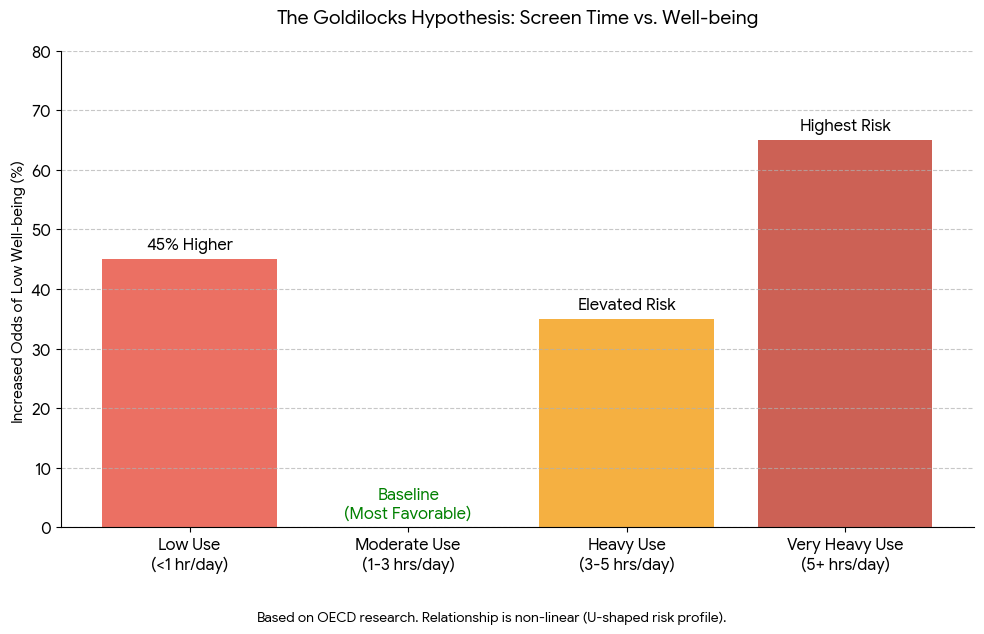
This aligns with broader evidence from OECD research on screen time and well-being. The relationship between screen time and subjective well-being is non-linear:
Key Insights from the Data:
- The Non-Linear Relationship: Unlike a direct linear relationship (where more of something is always worse), screen time follows a U-shaped risk curve. Both too little and too much screen time correlate with lower well-being.
- The "Sweet Spot" (Moderate Use): 1–3 hours of daily use is associated with the most favorable well-being outcomes.
- Low Use Risks: Surprisingly, under 1 hour of daily use carries significant risks, with 45% higher odds of low life satisfaction and 41% higher odds of low eudaimonia compared to moderate users.
- Heavy and Very Heavy Use: Risks begin to elevate after 3 hours and reach their peak at 5+ hours, which represents the highest risk for poor mental health outcomes.
This data suggests that digital engagement can be beneficial for well-being when used in moderation, as it likely facilitates social connection and information access without displacing other healthy activities like sleep or exercise.
The Focused Human Lens:
Duration is a poor proxy for impact because it treats all energy expenditure as equivalent.
Five hours of focused work and five hours of compulsive scrolling both register as screen time, but the thermodynamic signatures differ completely:
- One builds coherence through directed attention
- The other disperses energy through fragmentation
The distinction is physical. Your nervous system pays different metabolic costs depending on how information arrives and how you process it:
- Passive consumption taxes the system differently than active creation
- Social comparison triggers different neural cascades than collaborative problem-solving
The research confirms what the EIH says:
It is the informational structure of the experience, not the duration, that determines energetic cost.
When you engage online with intention—creating, connecting, learning—you are directing energy through specific pathways.
When you engage reactively—scrolling, comparing, consuming—energy disperses along paths of least resistance.
Both require time. Only one builds structure.
The practical implication:
Measure quality before quantity.
Ask yourself:
- What am I doing online? (not how long)
- What do I feel afterward? (not how many minutes passed)
Your attention organizes around coherence or it dissipates into noise. The medium does not determine the outcome. The mode of engagement does.
That is the variable under your control.
What This Means for You
Attention is energy—directed, organized, and accumulated over time into the structure you call consciousness.
Every moment of focus is an informational event with physical consequences:
- The traces persist
- The accumulation creates direction
- Direction is how coherence emerges from noise
You are participating deliberately in the physics of how attention becomes structure, and structure becomes self.
This is what it means to be a focused human in a world designed to fragment.
A. Karacay is the author of The Focused Human series — The Focused Human, The Attention Effect, and The Human Energy Advantage — available on Amazon. Listen to The Focused Human podcast, available wherever you listen to podcasts.
If you're looking for a weekly practice to help you direct your attention more deliberately, the Weekly Attention Reset Protocol is designed for exactly this. It's free, simple, and built to help you reclaim coherence in a world designed to fragment it. And, as always, stay curious!
Attention is Physics®